
Call For Papers
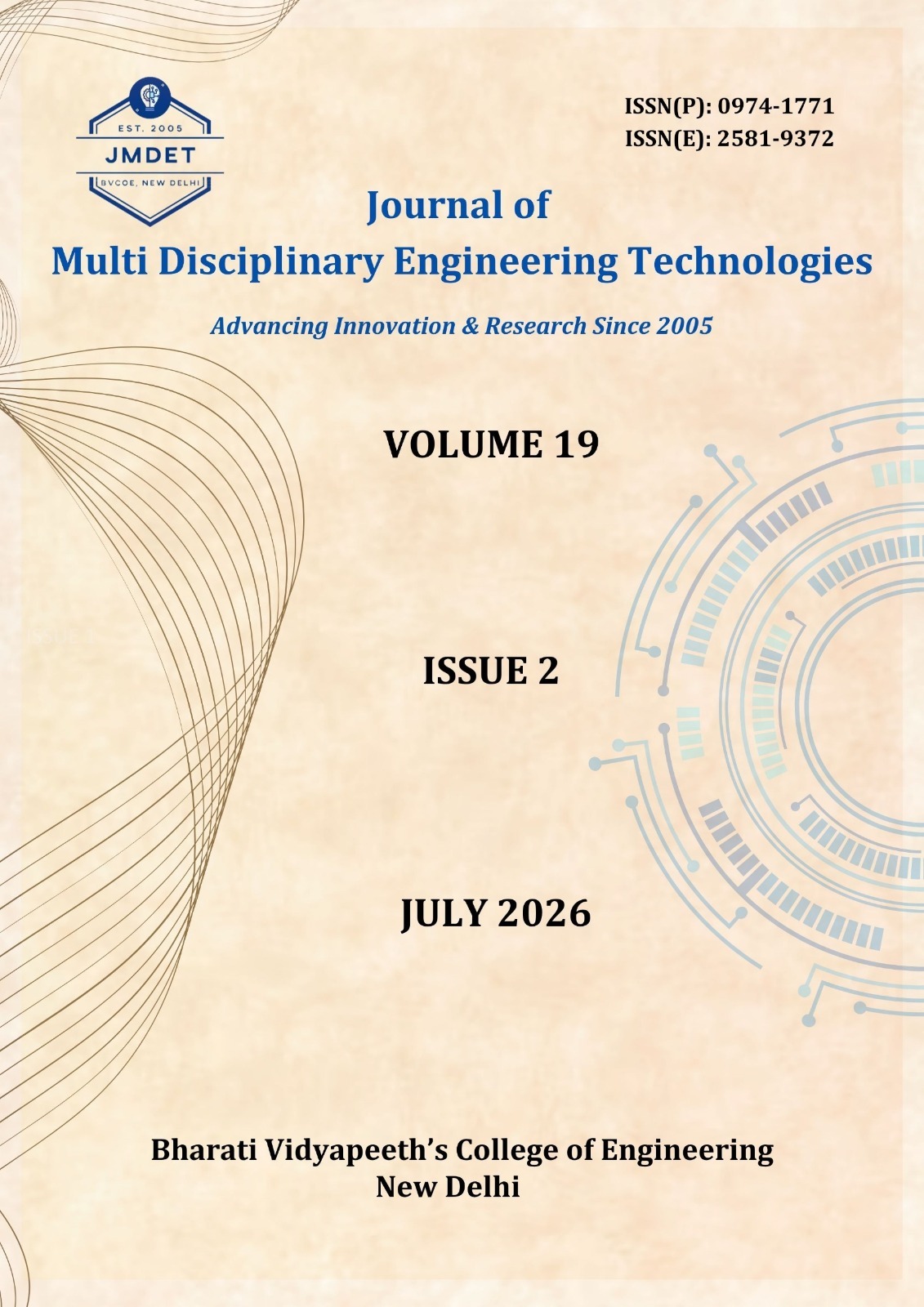
The Journal of Multi Disciplinary Engineering Technologies (JMDET) invites researchers, academicians, scientists, professionals, and students to submit original research contributions for forthcoming issues. The journal welcomes original research articles, review articles, case studies, and other scholarly contributions covering significant developments in Engineering, Science, Technology, and interdisciplinary areas.
Submitted manuscripts should present original, rigorous, and relevant research with a clear scientific or technological contribution. All manuscripts are subject to the journal's peer-review process and editorial policies. There is no publication charge for accepted manuscripts.
Authors are invited to submit their manuscripts for consideration in forthcoming issues of JMDET.
Submit Your ManuscriptDeclaration of Generative AI in Scientific Writing
Authors may use generative AI and AI-assisted tools to support manuscript preparation, provided that such use is conducted responsibly and under appropriate human oversight. Authors remain fully responsible and accountable for the accuracy, originality, integrity, and final content of their manuscript. Any substantive use of generative AI or AI-assisted tools in manuscript preparation, including assistance with drafting, restructuring, translation, or substantive language editing, should be disclosed in a declaration at the end of the manuscript, before the References.
The declaration should identify the AI tool used, its purpose, and the extent of its use. Authors must review and verify all AI-generated content and ensure that the manuscript reflects their own scientific analysis, interpretation, and contribution. Routine use of basic tools for spelling, grammar, punctuation, or formatting checks does not require disclosure. AI tools must not be listed as authors or co-authors. Where generative AI is used in the research process, such as data analysis, methodology, or generation or modification of research-related content, its use should be appropriately described in the relevant section of the manuscript.
During the preparation of this manuscript, the authors used [NAME OF TOOL/SERVICE] for [PURPOSE]. The authors reviewed and edited the generated content as necessary and take full responsibility for the content of the published work.
Corrections and Article Retraction
JMDET is committed to maintaining the accuracy and integrity of the published scholarly record.
Corrections
Authors are expected to promptly notify the Editor if they identify a significant error or omission in a published article. After editorial assessment, a Correction/Erratum may be published when an error affects the accuracy or completeness of the article but does not invalidate its main findings or conclusions. The correction notice will be permanently linked to the original article.
Article Retraction
An article may be retracted when its findings or conclusions are found to be unreliable or when serious violations of publication ethics are established. Grounds for retraction may include fabrication or falsification of data, plagiarism, duplicate publication, major undisclosed conflicts of interest, serious authorship or ethical violations, or substantial errors that invalidate the findings or conclusions.
Retraction decisions are made by the Editor following appropriate assessment of the concerns and available evidence. A retraction notice will clearly identify the article and state the reason for retraction. The original article will remain part of the scholarly record and will be clearly identified as retracted, with the retraction notice permanently linked to it.
JMDET follows established principles of publication ethics and scholarly publishing, including relevant COPE guidelines, in handling corrections and retractions.
Editorial Independence
JMDET is committed to maintaining editorial independence and academic integrity. Editorial decisions on the acceptance, revision, or rejection of manuscripts are based solely on scholarly merit, originality, scientific quality, relevance to the journal's scope, and the outcome of peer review. The Editor-in-Chief and Editorial Board are responsible for editorial decisions and exercise independent judgment in accordance with the journal's policies and publication ethics. Such decisions shall not be influenced by commercial, financial, institutional, personal, political, or other non-scholarly interests.
The journal's publisher and institutional owner may provide administrative and operational support but shall not interfere with decisions concerning individual manuscripts, peer reviewers, or published content. Editors and reviewers are expected to disclose and appropriately manage any conflicts of interest that could affect editorial judgment. Where an editor has a conflict of interest, the manuscript will be handled independently by another qualified editor. JMDET follows established principles of editorial independence and publication ethics, including relevant guidance from the Committee on Publication Ethics (COPE).